
Merchant Services & Payment Processing
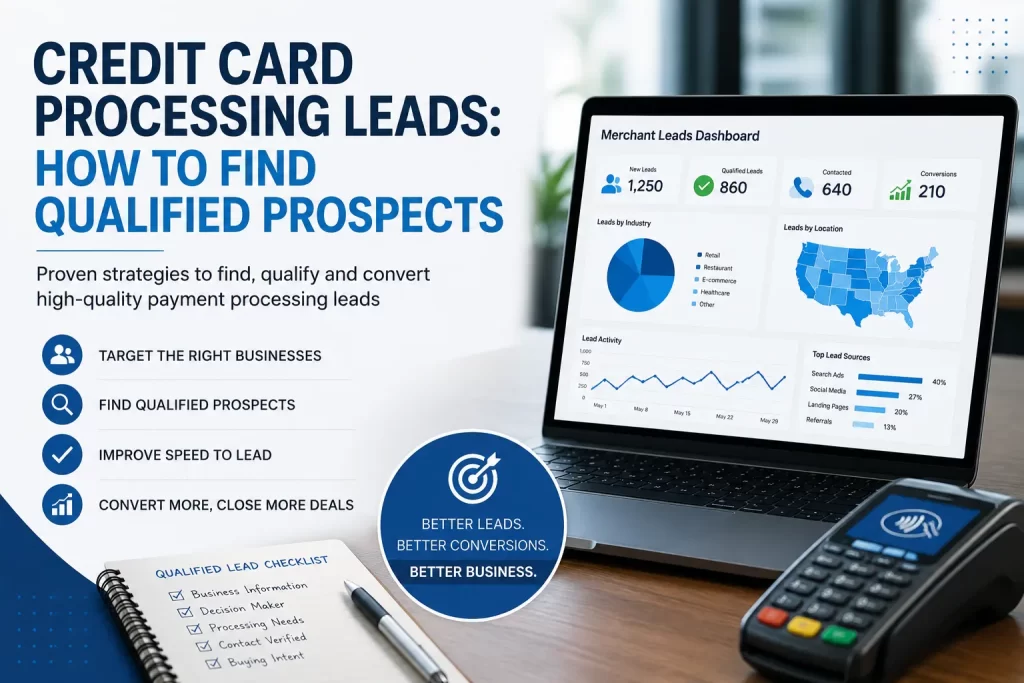
Finding businesses that need credit card processing is only the first step. The real challenge is identifying prospects that fit your market, have a genuine payment-processing need, and can be reached while their interest is still fresh.
For merchant service providers, ISOs, payment processors and other businesses selling payment solutions, lead quality can make a bigger difference than lead volume. A large database of businesses may give a sales team plenty of names to call, but it does not necessarily give them people who are likely to have a conversation.
Credit card processing leads can be approached in several ways, including referrals, outbound prospecting, inbound campaigns, targeted business data and leads generated from people who have recently shown interest in payment services.
This guide explains the differences between those sources, what makes a lead worth pursuing, and how sales teams can build a more reliable pipeline of credit card processing prospects.
What Are Credit Card Processing Leads?
Credit card processing leads are businesses or decision-makers who may be interested in accepting credit and debit card payments through a payment processor or merchant services provider.
Depending on how the lead is generated, the prospect may already be looking for a new processor, comparing rates, considering a different point-of-sale solution, opening a new business, or simply be a qualified business that fits the seller’s target market.
That distinction matters. A business list and a sales lead are not necessarily the same thing. A business list can be useful for prospecting, but a lead becomes more valuable when there is additional information about the business, its likely needs, its decision-maker, or its current buying intent.
What Makes a Credit Card Processing Lead Qualified?
Qualification depends on your sales model, but most payment-processing teams can evaluate prospects using a few practical criteria.
1. The business fits your target market
Start with the basics. Does the business operate in the geography and industry segments your team serves? Does its size, transaction profile, or business model make sense for your offer?
2. There is a relevant payment need
A strong prospect should have a plausible reason to consider a payment-processing solution. That could include opening a new location, changing providers, looking for different rates, adding card acceptance, upgrading a POS system, or solving an existing payment-related problem.
3. The contact information is usable
Accurate phone numbers, email addresses and business information matter because sales representatives cannot qualify an opportunity they cannot reach. Data quality should therefore be part of your lead evaluation process.
4. The prospect can influence the decision
The right contact may be the owner, partner, manager, finance decision-maker, operations leader or another person responsible for payment processing. The exact role depends on the size and structure of the business.
5. Timing makes sense
Timing is often overlooked. A business that matches your ideal customer profile but has no current need may require months of nurturing. A prospect that has just started evaluating payment options may be much more valuable to a sales team today.
Where Can You Find Credit Card Processing Leads?
There is no single lead source that works for every merchant services business. A good strategy usually combines several channels and measures the results from each.
Referrals and existing customers
Existing customers can be a valuable source of introductions. If a customer has a positive experience with your company, they may know other business owners who need payment services.
Outbound prospecting
Sales teams can build their own prospect lists and contact businesses by phone, email, social media or in person. This gives you control over targeting, but it also requires time for research, list building and qualification.
Inbound marketing
Search, paid advertising, social media, educational content and landing pages can generate inbound demand. These channels can be powerful because prospects may discover your company while researching payment solutions.
Targeted business data
Business data can help sales teams build a market based on geography, industry, company characteristics and other criteria. It is most useful when combined with a clear qualification process rather than treated as a finished sales pipeline.
Real-time or intent-based leads
Another option is to work with lead sources that deliver prospects after they have expressed an interest or raised their hand for a relevant service. The advantage is timing: the sales team may have an opportunity to contact the prospect while the need is still active.
If your team is buying rather than generating leads internally, exclusive merchant services leads can be another way to supplement an outbound sales pipeline.
Real-Time vs. Fresh vs. Aged Leads
Lead age is worth understanding before comparing different lead sources. The terms can mean different things from one provider to another, so buyers should ask exactly when a lead is generated and when it is delivered.
| Lead type | What it generally means | Main consideration |
|---|---|---|
| Real-time | Delivered close to the time a prospect is qualified or expresses interest. | Speed of follow-up becomes especially important. |
| Fresh | Recently generated or updated prospects that are not necessarily delivered instantly. | Ask how freshness is defined by the provider. |
| Aged | Older prospects that may still be useful for outbound campaigns. | Pricing may be lower, but contact and intent can vary. |
Real-time delivery does not automatically make a lead good, just as an older lead is not automatically bad. The important question is whether the lead matches your market and whether the timing, data quality and buying intent make sense for your sales process.
Why Speed-to-Lead Matters
When someone has recently shown interest in a payment solution, the sales opportunity can be time-sensitive. Waiting too long can make it harder to connect while the prospect is actively thinking about the problem.
For teams receiving real-time leads, the operational process matters just as much as the lead source. Leads need to reach the right representative quickly, and representatives need a clear follow-up process.
A practical workflow might look like this:
- A prospect is qualified or signals interest.
- The lead is delivered to the appropriate sales representative or CRM.
- The representative reviews the available information.
- The representative attempts contact while the need is still fresh.
- The outcome is recorded so the team can measure contact and conversion rates.
The exact process will vary by company, but the principle is simple: a good lead source works best when the sales operation is ready to act on it.
How to Qualify Credit Card Processing Leads
Before spending too much time on any prospect, create a simple qualification framework. It does not need to be complicated.
Consider asking:
- What type of business is this?
- Where is the business located?
- Who handles payment processing decisions?
- Does the business currently accept credit and debit cards?
- Is the business considering a new processor or payment solution?
- Are there specific processing, POS or pricing issues the prospect wants to solve?
- Does the prospect fit the types of accounts your company can support?
The goal is not to interrogate every prospect. The goal is to quickly determine whether the opportunity is worth a deeper conversation.
How to Compare Credit Card Processing Lead Providers
If you purchase leads, compare providers based on more than the advertised price per lead. A cheaper lead can become expensive if your representatives spend their time chasing invalid or poorly targeted contacts.
Ask about lead source
Find out how the prospects are generated. Are they business records, inbound inquiries, outbound-generated prospects, referrals, or another type of lead?
Ask about freshness
“Fresh” can mean different things. Ask when the prospect was generated, when it was last verified, and how quickly it can be delivered.
Ask about targeting
Find out whether you can target geography, industry, business profile, or other criteria important to your sales strategy.
Ask what verification means
A provider should be able to explain what it checks and what happens when a lead does not meet the agreed criteria.
Ask about exclusivity
If a provider says leads are exclusive, clarify exactly what that means. Does one prospect go to one buyer, or can the same lead be sold across multiple buyers?
Ask about delivery
If speed matters to your sales team, ask whether leads can be delivered in real time and how they are pushed into your CRM or sales workflow.
How Much Do Credit Card Processing Leads Cost?
There is no single market price for a credit card processing lead. Cost can vary significantly depending on the source, qualification level, exclusivity, targeting, freshness, geography and volume purchased.
Instead of looking only at cost per lead, calculate the cost through your sales funnel:
Cost per lead → How much you pay to acquire the prospect
Cost per conversation → Cost after accounting for your contact rate
Cost per appointment → Cost after qualification and booking
Cost per signed account → The metric that matters most for many payment-processing sales teams
This approach helps you compare a low-cost, high-volume source with a more targeted source on the metric that actually affects revenue.
Credit Card Processing Leads vs. Merchant Services Leads
The two terms overlap, but they are not always used in exactly the same way.
Credit card processing leads are generally focused on businesses that may need or be interested in processing card transactions.
Merchant services leads can be broader and may include prospects interested in merchant accounts, payment processing, POS systems, payment technology and related services.
In practice, a business looking for a new credit card processor may also be a merchant services prospect. That is why payment processors and merchant service providers often evaluate both categories when building their sales pipeline.
Build a Better Credit Card Processing Sales Pipeline
The strongest lead-generation programs usually combine good targeting with disciplined sales execution. A useful framework is:
- Define your ideal customer. Know which businesses you want before you start buying or generating leads.
- Choose complementary lead sources. Combine referrals, outbound prospecting, inbound demand and purchased leads where appropriate.
- Set qualification rules. Decide what makes a prospect worth pursuing.
- Respond quickly. Especially when working with real-time or high-intent leads.
- Track outcomes. Measure contact, appointment, application and close rates by source.
- Improve based on results. Increase investment in sources that produce qualified conversations and signed accounts, not simply the largest number of leads.
Looking for Credit Card Processing & Merchant Services Leads?
If your sales team wants to supplement its prospecting with targeted, fresh merchant opportunities, explore merchant account and merchant services leads from Leadscampus.
Frequently Asked Questions
What are credit card processing leads?
Credit card processing leads are businesses or decision-makers who may be interested in accepting card payments or evaluating a payment-processing provider.
Where can I find credit card processing leads?
Common sources include referrals, outbound prospecting, inbound marketing, targeted business data and lead providers that generate or deliver prospects based on specific criteria.
Are real-time credit card processing leads better?
Real-time delivery can be valuable when a prospect has recently shown interest because it gives the sales team an opportunity to respond while the need is fresh. Lead quality and fit still matter, so real-time delivery should be evaluated alongside qualification and data quality.
How should I qualify a credit card processing lead?
Evaluate the business’s industry, location, size, payment needs, decision-maker information, current processing situation and any indication that the business is considering a change.
What is the difference between credit card processing leads and merchant services leads?
Credit card processing leads are generally focused on card-payment processing needs, while merchant services leads can cover a broader range of payment-related products and services. There is significant overlap between the two.
Final Takeaway
Generating credit card processing leads is not simply about collecting more business contacts. The goal is to build a pipeline of prospects that fit your market, have a relevant payment need, can be reached, and can be acted on at the right time.
Start with a clear ideal customer profile, compare lead sources based on actual sales outcomes, and give your team a process for fast follow-up and qualification. Over time, your own conversion data will tell you which sources are producing the best opportunities.
For sales teams that want to add targeted prospects to their pipeline, explore exclusive merchant account leads and see how they can complement your existing credit card processing prospecting strategy.
